

This article was originally published in June 2023. It has been refreshed with new information.
Endpoint management software is becoming increasingly popular as enterprises aim to mitigate attacks from external entities. This is further amplified by hybrid and remote work scenarios that have increased external endpoints due to employees' devices.
Endpoint management software tracks devices in a system and ensures software is secure and up to date. Typical features of endpoint management products include asset management, patch management, and compliance evaluation.
Most organizations have no idea what the current security state is of all their endpoints. It is one of the leading causes of enterprise breaches. Unifying endpoint security reduces the number of unknown endpoints and prevents future attacks.
As economic uncertainty has tightened budgets, security customers are becoming more selective about their overall spending. At this point, organizations examine security software to consolidate and improve cybersecurity while being budget-conscious.
These organizations want to improve security with efficiency, the key word being consolidation. When it comes to endpoint management software, enterprises are looking for solutions that will also provide greater resilience. Organizations are examining their security software stack with consolidation in mind - seeking tools that eliminate redundant agents, reduce licensing costs, and improve resilience through a single unified endpoint management console.
These tools have many overlapping features with vulnerability management software and mobile device management (MDM) software products. Endpoint management solutions have a wider scope of capabilities than vulnerability management tools like device governance and device compliance. While endpoint management software helps secure all endpoints, MDM tools typically only manage remote workers and mobile devices.
AI and machine learning have moved from buzzwords to operational capabilities embedded in endpoint management platforms. The core shift: rather than triggering patch cycles on a schedule, AI-powered tools prioritize vulnerabilities based on real-world risk - factoring in exploit activity, asset criticality, and exposure context. G2 now recognizes Autonomous Endpoint Management (AEM) as its own distinct software category - separate from broader endpoint management.
Hundreds of verified G2 reviews are already being tagged under AEM, reflecting a buyer base that is actively evaluating AI-native endpoint tools. G2 data also shows that reviewers consistently point to the same pain point: reactive IT workflows that can't keep pace with the volume and speed of modern threats. There is a shift happening faster than ever before - moving from checking devices one by one to having issues surfaced automatically and from scheduling patches manually to having platforms handle deployment and prioritization without intervention.
G2 data validates sustained enterprise interest in endpoint management. According to G2's Endpoint Management category data (updated June 2026), users highlight patch management automation and device compliance monitoring as the most valued features. IT teams frequently cite real-time detection of unapproved devices and centralized endpoint visibility as key reasons for adopting dedicated endpoint management tools over broader security platforms.
According to G2, the desired endpoint management software capabilities are:
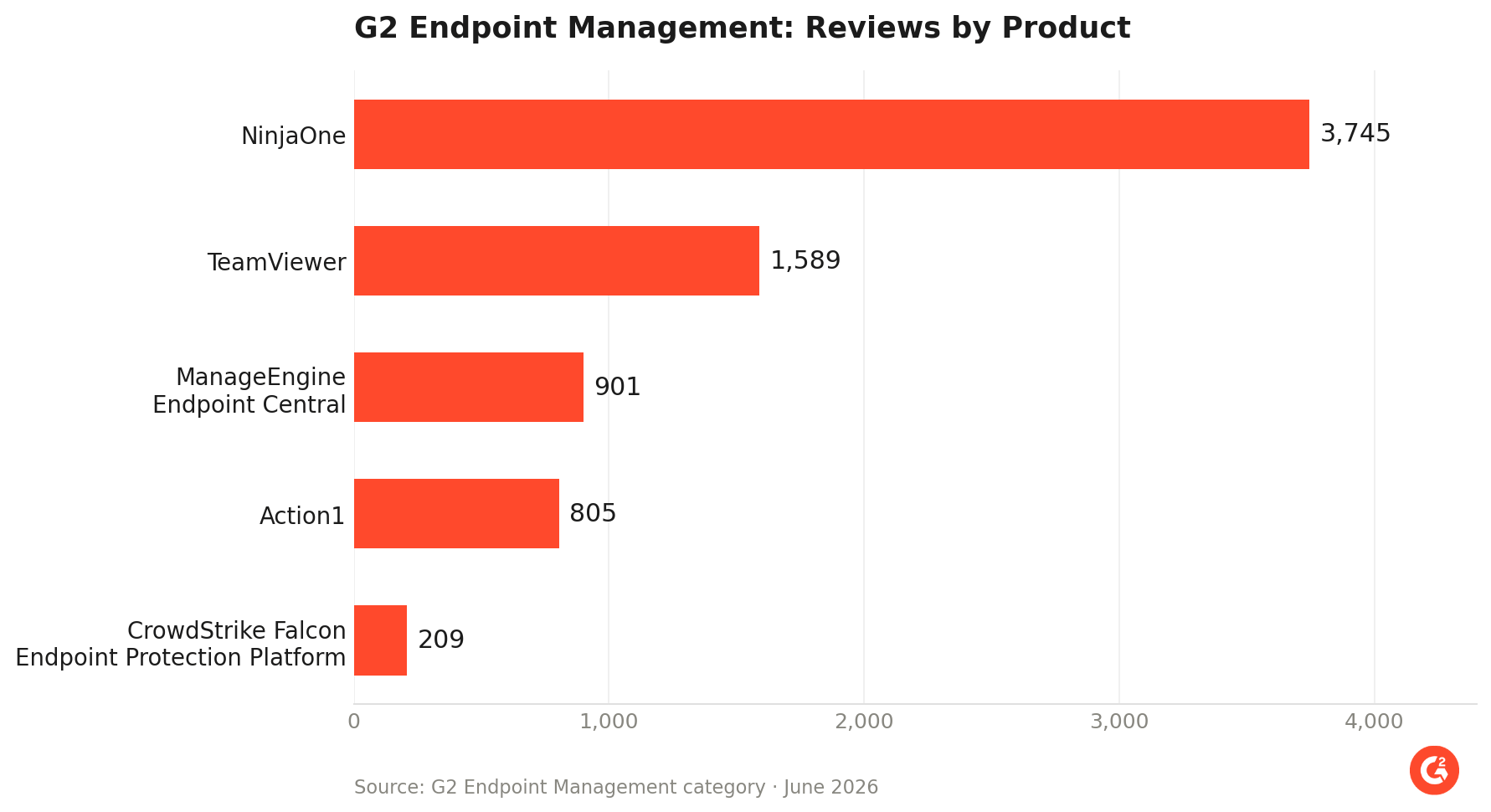

Some of the key challenges endpoint management software buyers are facing today are:
Now more than ever, hackers are trying to exploit unprotected endpoints. Security and IT teams must address the challenges of improving endpoint security in response.
Autonomous endpoint management (AEM) is emerging as a distinct capability within this space, enabling endpoints to self-patch and self-remediate without waiting for manual IT intervention - a critical advantage as attack speeds continue to outpace traditional patch cycles. The generative AI security risk landscape is also raising the stakes, as attackers use AI to accelerate and scale intrusion attempts.
Every organization must take these steps to protect itself from attackers who are already using generative AI and advanced multifaceted attacks to steal identities and breach endpoints undetected.
See what 916 G2 reviews reveal about Autonomous Endpoint Management (AEM) in 2026.


Vulnerability scanner software is becoming increasingly popular as enterprises want to...
by Sarah Wallace

In organizations today, employees not only use company devices to access sensitive...
 by Tian Lin

Generative AI is an artificial intelligence technology that can produce various types of...
by Sarah Wallace







.png?width=32&height=32&name=Subtract%20(6).png)