

To help buyers make sense of the data privacy software landscape, I will write several articles on various functions of data privacy software. My aim is to provide our readership with overviews and practical advice when buying data privacy software of all kinds. Our first installment is an overview of data privacy management software.
There isn’t a standard that’s developed for Data Privacy Management Software yet, and products are quickly expanding their offerings with loads of recent investment money flowing in to further develop that functionality. For example, in January 2020 alone, two major privacy-software vendors, Securiti.ai and BigID, both separately announced investments of $50 Million each. This is not to mention the flurry of investments that took place in late 2019 prior to the CCPA going into effect, such as start-up DataGrail getting backed as part of Okta’s $50 Million venture fund, nor consolidation in the space with acquisitions like TrustArc’s acquisition of Nymity or OneTrust’s acquisition of the IAPP’s Privacy core eLearning solution.
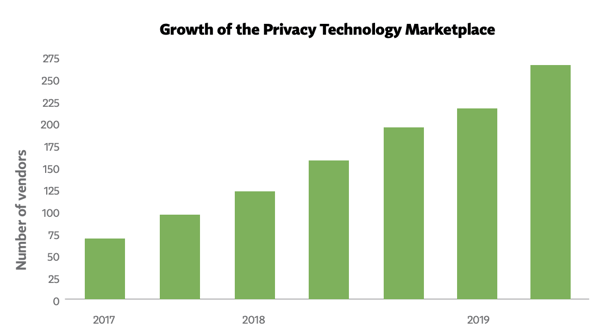 Source: 2019 IAPP Tech Vendor Report
After reviewing slews of software currently available in this dynamic space, however, here’s how we at G2 are defining this category of software, for now.
Data Privacy Management software helps companies manage their privacy programs to comply with global privacy laws such as the EU’s General Data Protection Regulation (GDPR) or the California Consumer Privacy Act (CCPA), among other regulations. The main functionality of Data Privacy Management software includes:
1. Sensitive data discovery and mapping
2. Data Subject Access Request (DSAR) management (or consumer request management) and
3. Consent management platform
These software solutions often provide additional functionality such as (or integrate with other applications, to provide) vendor assessment management, cookie compliance, data breach notification, identity verification, data de-identification or pseudonymity, privacy impact assessments (PIA).
Let’s take a closer look at the most fundamental features of Data Privacy Management software, which include three main features:
General questions to consider when selecting a data privacy management software solution:
Can you confidently say that you know where all of your company’s personally identifiable information (PII) and sensitive data reside? What about data in your databases, applications, email platforms, or even endpoints like employee laptops or mobile phones? How about sensitive information stored in old emails? Further questioning, do you know where you got that data from and from whom? And where is the data now going? In order to comply with data privacy laws, companies must know where their sensitive data is located and how it is used.
Data privacy management software solutions today assist companies with understanding where their sensitive data is in three ways, via:
There are advantages and disadvantages to both the survey-based data discovery method and the automated discovery method. For survey-based data discovery, this is not a technological lift, rather one of process. Since employees who manage the data fill out these surveys, user error or incompleteness can be a critical issue. Furthermore, the results of this exercise are static as of when the data was reported. We know new data is made every day, so the information will be outdated from the date it was generated.
For automated data discovery, the benefits are that when implemented, it is an automatic process that does not require employees to find sensitive data and the results are dynamic and up to date. The limits with automated data discovery are that it must be able to connect to not only your cloud storage and cloud applications, but your on-prem databases and legacy applications, as well. Some vendors that provide automated discovery are willing to build custom APIs to connect to legacy stores to address this issue, however.
Questions to consider when selecting an automated data discovery tool:
For small businesses or businesses with a low amount of sensitive data, survey-based may be sufficient for now. Survey-based sensitive data discovery is also a way to find data that may live on legacy systems or in applications that cannot be discovered using an automated method, such as literal paper files. For large enterprises and companies that have embraced the digital transformation or are digital natives, however, automated discovery would be easy to add to your mix of other SaaS products. From an industry perspective, I have seen a number of investments in automated data discovery, so I do believe long term, this method is the way of the future.
So what happens when you get a request from a data subject (a consumer, employee, or other end user) requesting to access, port, or delete their data? How do you manage those requests within the legally defined response timeframes?
| Related:Learn more about process data portability requests, here.→ |
Data Subject Access Request (DSAR) software functionality generally includes providing a DSAR intake form or portal to accept data subject’s request to access, port, or delete their personally identifiable information; identity verification methods; provide a centralized view of all DSARs in process; alerts to administrators when it is getting close the legally mandated response time; provides workflow tools to process DSARs across your organization; and provide reporting tools and logs. Some tools also offer an encrypted communication portal to securely communicate and transfer DSAR data to a data subject.

Questions to ask vendors about their Data Subject Access Request (DSAR) management functionality:
An important feature that is becoming more common in data privacy management software is consent management, as many data privacy regulations require either opt-in or opt-out consent from users before collecting, using, sharing, or selling their user data. Getting user consent right is critical. To adhere to user consent and preferences, companies can employ consent management tools.
With consent management tools, users can consent to a whole host of data usage by companies, including right to data collection, location tracking, contact preferences including sms, email, phone, and more. End users can even set collection and usage permissions for their IoT devices. Employing consent management tools makes adhering to data privacy regulations much easier.
This article provides a high-level overview of Data Privacy Management software. My aim is to write more in depth information on the functionality of data privacy management platforms, as well as content about other privacy-related software. Follow my content on G2’s research site for updates. You can also follow me on LinkedIn.
Disclaimer: I am not a lawyer and am not offering legal advice. If you have legal questions, consult a licensed attorney. I also don't give fashion advice, relationship advice, or movie recommendations. Trust me, this is for the best.

The most valuable public companies in the world today are all driven by data.
by Merry Marwig, CIPP/US

G2’s 2022 Fall Reports for software categories are out. Let’s get an update on the state of...
by Merry Marwig, CIPP/US

Ever been fed up with your cell phone provider? Maybe you had a good deal the first few...
by Merry Marwig, CIPP/US







.png?width=32&height=32&name=Subtract%20(6).png)