

This article was originally published in October 2023. It has been refreshed with new information.
The rise of generative AI is one of the most significant developments in recent history. It's already impacting the lives of professionals across industries.
Many teams are trying to integrate this game-changing technology into their workflow, and software development teams are no exception. One of many areas of development that could be automated is the peer code review process.
In 2023, that was still a question on the horizon. In 2026, it's the daily reality for most engineering teams: a large share of newly committed code is now AI-generated or AI-assisted, and the bottleneck in the software development lifecycle has shifted from writing code to reviewing it.
Peer code review allows code to be examined by a developer other than the original author. Allowing developers other than the original developer to review software code reduces the risk of security vulnerabilities, bugs, issues, and missing requirements. This is done using peer code review software.
That definition hasn't changed - but what gets reviewed has. Peer review today covers code written by human developers and code generated by AI coding agents alike, and increasingly, both paths run through the same review pipeline.
Development teams are already seeing the impact of AI on the coding process. AI is taking many new roles across development, even going as far as creating its own code with AI code generation software.
This leads to many interesting questions about the future of peer code review. If AI generates its own code, do we still need peer code review? Can development teams just rely on software to review this code, or do human eyes still have a place in this process?
These questions have already been answered by G2's own review data. In an analysis of more than 3,000 verified reviews in G2's AI Code Generation category (submitted through August 2026), 92% of users rated their tool positively, with productivity and time savings cited as the most common benefit. But the same reviews surface a "grumble and tolerate" pattern: accuracy complaints show up in roughly 12% of reviews category-wide - as high as 23% for general-purpose tools like ChatGPT - even as reviewers rate output accuracy a category-wide 4.35 out of 5 on a direct, structured survey question.
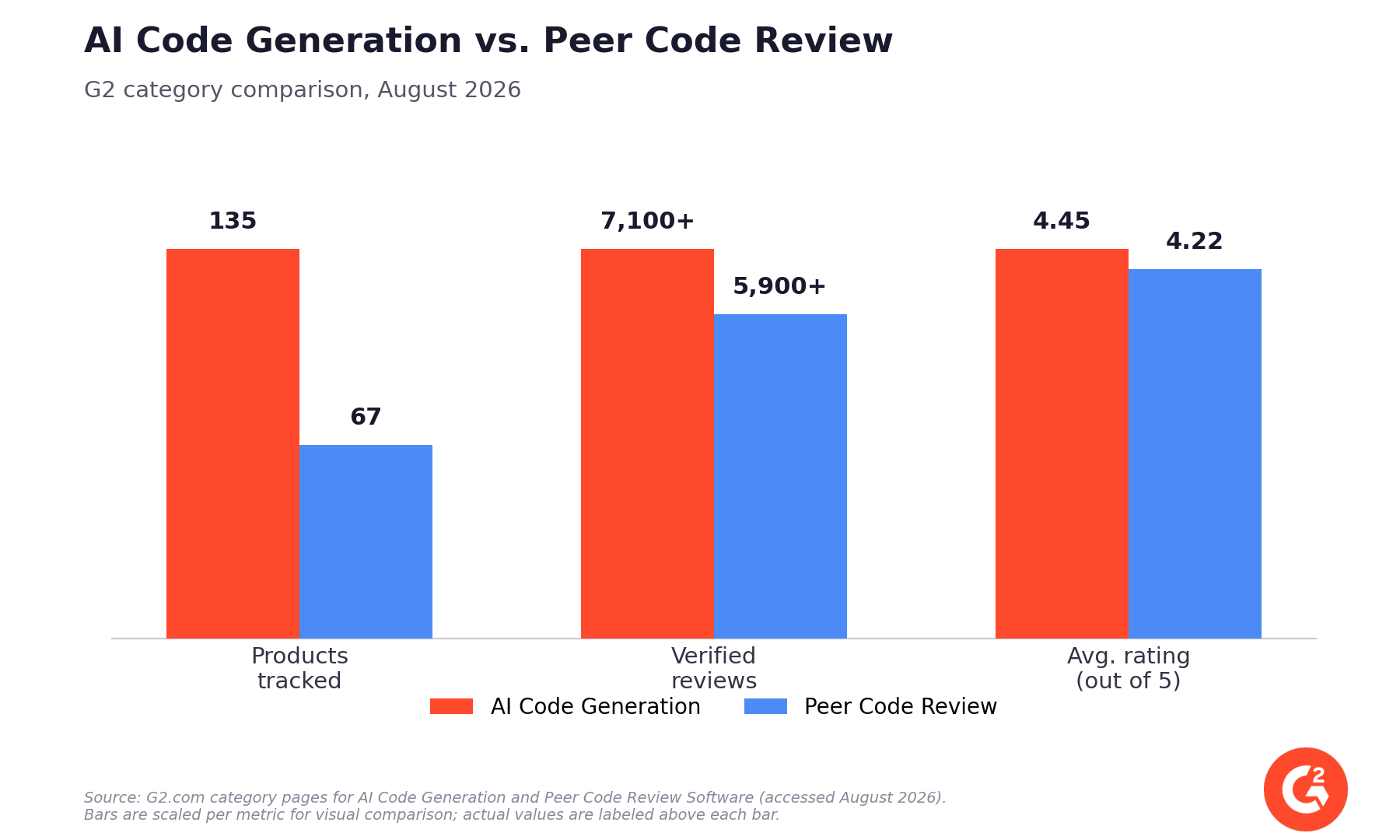
Developers are naming real friction and still calling the tools worth it, which is exactly the condition that makes a review step necessary rather than optional. A distinct category of AI-native code review tools has emerged specifically to handle the volume that creates: CodeRabbit, Greptile, Sourcery, and Qodo now sit alongside traditional peer review platforms in G2's category, built to semantically understand a whole codebase rather than just flag syntax issues.
The clearest sign that this shift is real: developers now report spending more hours per week reviewing AI-generated code than writing new code, a reversal of the pattern from just two years earlier. The volume of pull requests generated by AI coding agents has outpaced the human capacity to review them, turning the PR queue itself into the new bottleneck - which is exactly the gap AI-native review tools were built to close.
When observing the reviews on the G2 category page for peer code review products, it quickly becomes apparent that AI and automation are regular themes.
Many reviewers directly list AI as one of the key benefits they appreciate in peer code review products. Many reviews directly or indirectly cite automation, with one going as far as saying they love to “automate everything.”
That said, it is also clear that not everything can be automated, and many reviews acknowledged that. Even the reviewer who wanted to “automate everything” recognizes that there are “key parts” that a human needs to review as well.
By 2026, "a noteworthy theme" understates it. AI-native review products are no longer a fringe add-on to the category - they're among its most visible leaders.
Q1. Does AI code review replace peer review?
Not entirely. AI-native tools handle the volume - flagging issues, suggesting fixes, checking context across a codebase - but design decisions, UX judgment, and evaluating whether code solves the right problem still need a human in the loop.
Q2. Why has demand for AI code review tools grown so fast?
AI coding agents now generate a large share of new code, and the resulting pull request volume outpaced teams' capacity to review it manually. AI-native review tools like CodeRabbit and Greptile emerged specifically to close that gap.
Q3. What should engineering teams do to keep up?
Pair AI-native review tools with existing peer review practices rather than replacing one with the other, and treat AI-generated pull requests with the same or greater scrutiny as human-written code.
While there’s no doubt that AI will continue to make itself known in code review, there is still a role for human developers.
People still lead the charge when it comes to decision making, designing, and refining the details of software and applications. They are also essential when it comes to user feedback, as it takes empathy and patience to make development decisions that strengthen the overall user experience.
While there will always be concerns about job security and AI, most of the benefits AI brings to development are more likely to help developers than anything. Automation should be focused on aiding developers rather than removing people from the equation.
Peer code review is just one example of a tedious aspect of coding being replaced by artificial intelligence. Human developers will still be needed for application design, user experience improvements, and more.
A peer code review software that incorporates automation can take over the tedious work of developers. This frees them up to work on more complex challenges requiring human interaction, such as incorporating user feedback, making design decisions, and refining software.
That said, "AI handles the tedious work, humans handle the judgment calls" is a cleaner story than the 2026 data fully supports. The rise in defect rates and review time shows that AI-generated code still needs real scrutiny, not a rubber stamp - the tools that succeed are the ones that make thorough review faster, not the ones that make review feel optional.
Learn more about AI Code Generation and what 3000+ reviews reveal


On December 10, 2021, CloudBees announced that they raised $150 million in Series F funding....
by Michael Pigott

2023 will forever be remembered for the rise of generative AI, and software development is no...
by Michael Pigott

Editing text can be a surprisingly complex challenge for several organizations. Many software...
by Michael Pigott







.png?width=32&height=32&name=Subtract%20(6).png)